From the Cosmos to Us
ExhibitionEvent
Name
From the Cosmos to Us
Do Cosmos a Nós
Description
Explore a multimedia narrative structured around five major moments – Cosmos, Earth, Anthropocene, Tomorrows and Us – each one embodying the great questions that humanity has always asked itself – Where do we come from? Who are we? Where are we? Where are we going? How do we want to go?
Percorra uma narrativa multimídia estruturada em cinco grandes momentos – Cosmos, Terra, Onde Estamos?, Amanhãs e Nós – cada um encarnando grandes perguntas que a humanidade sempre se fez – De onde viemos? Quem somos? Onde estamos? Para onde vamos? Como queremos ir?
PLace
Main exhibition
Partner(s)
Globo News
AFP
DW
Instituto Cultural Vale
Program
Main exhibition
Tickets
https://site.bileto.sympla.com.br/museudoamanha/
Text
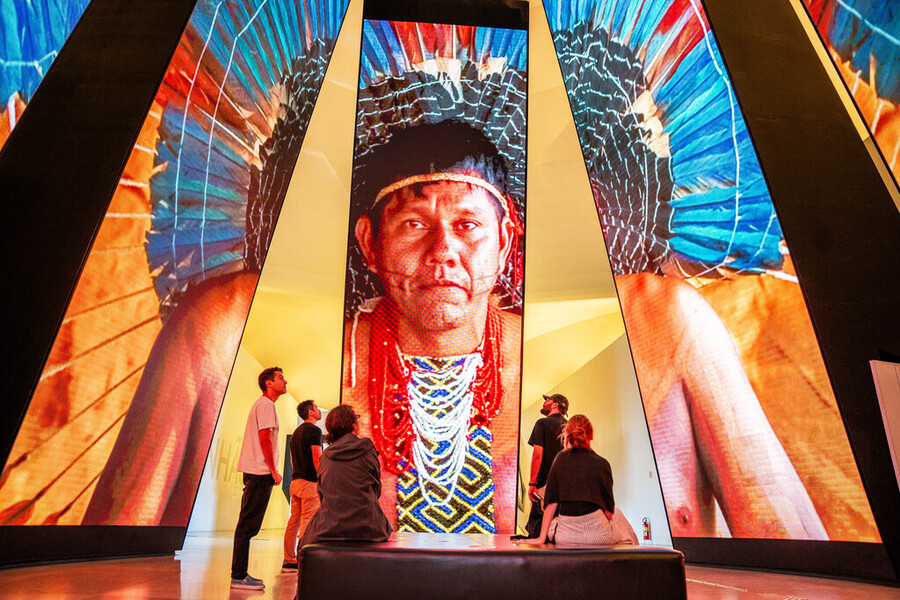
The Main Exhibition of the Museu do Amanhã, conceived based on a curatorial proposal by the doctor in cosmology Luiz Alberto Oliveira, in partnership with a team of specialized consultants, occupies the second floor of the Museum, where the public is led through a narrative structured in five main areas: Cosmos, Earth, Anthropocene [area temporarily closed] , Tomorrows and Us, which add up to more than 40 experiences available in Portuguese, Spanish and English. Cosmos addresses the idea that we are made of the same stuff as the stars, connecting us with the universe and our origins. Here, visitors begin to address the questions that will guide their journey: what are the dimensions of our existence? How did we get here? What future do we want? In Earth, three large cubes, seven meters high, with content that investigates the three dimensions of existence: Matter, Life and Thought. In the Life cube, for example, DNA, an element common to all species, is represented on the outside. Inside, the diversity and interconnectivity of life in the Atlantic Forest appear in a selection of photos produced during three expeditions carried out in the Guanabara Bay ecosystem. The next area, Anthropocene [area temporarily closed] , the focal point of the Main Exhibition experience, addresses the understanding that human activity has become a geological force: we are transforming the composition of the atmosphere, modifying the climate, altering biodiversity, changing the course of rivers. All life on Earth will have to adapt to these new times full of uncertainty – and opportunities. The Tomorrows space focuses on major global trends. There are more and more people in the world, living much longer. Gigantic cities and hyperconnectivity. We will live on a planet with intense changes in climate and biodiversity. We will continue to expand the frontiers of knowledge and improve technologies. How and where will we live? Visitors are invited to think about issues of sustainability and coexistence. The tour ends with an exercise of imagination in Us, which proposes that visitors engage in the idea that Tomorrow begins now, with the choices we make. Today is the place for action. Cosmos The first experience of the long-term exhibition at the Museu do Amanhã, Cosmos addresses the view that we are made of the same stuff as the stars, connecting us with the Universe and our origins. Here, visitors begin to deal with the questions that will guide their journey. How did we get here? Inside a dome, visitors are immersed in a 360-degree projection, traveling through galaxies, the heart of atoms and the interior of the Sun. They witness the formation of the Earth, the development of life and thought, manifested through art. The idea is that visitors can experience dimensions of our natural existence that we are not accustomed to experiencing without resorting to scientific instruments. From the micro to the macro, from astronomical magnitudes to subatomic scales. This is a sensorial, poetic, and motivating experience that presents us with the Cosmos as an evolutionary totality that far surpasses us, encompasses us, and constitutes us. Next to the dome, in the area called Cosmic Horizons, it is possible to deepen your knowledge with the help of six interactive screens. One of the ethical axes of the Museu do Amanhã is that of coexistence. Our experiences were created to involve everyone, without distinction. However, in order to maintain the quality of the experience, we do not provide subtitles when showing the Cosmic Portal film. Check out the transcription of the content narrated in the film: Earth The second part of the Main Exhibition, Earth, is associated with the question “Who are we?”. We are matter, life and thought. Far from being isolated, these three dimensions interact with each other and, in the exhibition, they are represented by three seven-meter-high cubes. All cubes have an interior and an exterior side. In the Matter cube, from the outside, visitors have a unified view of the Earth, as seen by Russian cosmonaut Yuri Gagarin. The Earth is seen not in its fragmented form, in countries or continents, but as a single star. In this experience, visitors see around 180 highly magnified photographs of the Earth. Inside the cube, visitors will become familiar with the different rhythms that mark the material functioning of the planet. Different flows are called “oceans”. The very slow movement of tectonic plates – a few centimeters per year –, the faster movement of ocean currents, the much faster ballet of winds in the air and the extremely rapid evolution of sunlight. These four rhythms combine to produce a new rhythm, which is the rhythm of the climate, of the succession of seasons. Next, we have the Cube of Life, whose “skin” refers to the biochemical support of the basic code that coordinates the composition and development of all living beings, DNA; while the interior presents the immense variety of organisms, which interact in multiple ways and integrate to form ecosystems. The diversity and interconnectivity of life in the Atlantic Forest appear in a selection of photos produced during three expeditions carried out especially for the Museu do Amanhã. We present the ecosystem of Guanabara Bay, where the Museu do Amanhã is located, in its varied habitats, from the top of Serra dos Órgãos to the coastal waters. We also exhibit the microbial ecosystem that each of us carries, and on which our health depends. The third cube, finally, presents the dimension of Thought. On the outside, we once again have a unifying element: our nervous system, which is essentially the same in all human beings. From this fundamental identity, however, results the incredible diversity of cultures, illustrated by hundreds of images that portray different aspects of our lives, feelings and actions – how we inhabit, celebrate, fight, belong. Where are we? The “Where Are We?” area proposes a reflection on the contemporary experience, which can be characterized as a time of transition, or a “post-normal time” that, according to some thinkers, is marked by three main features: complexity, contradiction, and chaos. Complexity refers to the recognition that everything is interconnected and interdependent. The individual pursuit of material comfort, convenience, and security – even though experienced unequally among people – has generated significant social and environmental consequences that are also unevenly distributed, while projecting challenging future scenarios. The contradictions are numerous, but perhaps the greatest of them is that we have never had so much scientific knowledge, yet at the same time this knowledge has not led us to transformative action, for example, regarding climate change. Chaos, in turn, has led society into a state of widespread exhaustion. Despite the conveniences brought by the increased speed of telecommunications and transportation, they have been accompanied by a relentless pursuit of performance and productivity rather than quality of life. In the exhibition, six ten-meter-high totems present audiovisual content about the “biotechnosphere,” a fusion of nature and technology as structuring force of the planet and modern human life. Inside the totems, visitors encounter the human impacts on the four elements – water, fire, earth, and air – and their effects on one another and on society. Tomorrows The Tomorrows area focuses on major global trends that will see more people living much longer in the world. Giant cities and hyperconnectivity. Living with people from the most diverse cultures and lifestyles will be part of our daily lives. How and where will we live? Visitors are invited to think about issues of sustainability and coexistence in three areas: Society, Planet and Human. There are many possible Tomorrows, full of unforeseen events. In the coming decades, we will probably be even more numerous, some living much longer. We will inhabit megacities, but with great social inequalities. We will live on a planet with intense changes in climate and biodiversity. We will continue to expand the frontiers of knowledge and perfect technologies, modifying our bodies and minds and expanding our presence in the Solar System. In a future of uncertainty and challenges, we will build Tomorrows based on our own choices, individual and collective. Tomorrow is defined by the question “Where are we going?”. The simulations, estimates and projections associated with this moment are arranged in an “origami”. It demarcates three areas, presenting six trends that will shape the future in the coming decades. The demarcated areas concern coexistence (society), living (planet), and being (person). The six trends are climate change; the increase in the world population by approximately 3 billion people in the next fifty years; the integration and differentiation of peoples, regions and individuals; the alteration of biomes; the increase in the number, capacity and variety of artifacts that we produce; and, lastly, the tendency towards the expansion of knowledge. These trends are presented in historical perspective through games, including the Civilization Game, based on a model studied by NASA. By examining examples from the past, the development and collapse of civilizations can be measured using variables such as resource consumption, population size, and social inequality. In the game, it is possible to control certain parameters going forward to make a civilization persevere or collapse. Us The Main Exhibition ends with the exercise of imagination in Us, proposing that visitors engage in the idea that Tomorrow begins now, with the choices we make. We live on a planet that has been profoundly transformed by our own intervention. Today is the place for action. What will our legacy be for future generations? Our actions, no matter how small they may seem, can change the world. If we connect with the planet and with each other in our differences, we will be a bridge to a sustainable future. It is always dawning, somewhere on the planet. Each dawn is always the same and also always different. Each of us makes our own Tomorrow. And together we make ours – the Tomorrows we want. We are structured around the environment of a hut, which symbolizes a house of indigenous knowledge, where members of the tribe's families and clans come to gather and the oldest repeat to the youngest the legends, narratives, and stories that form the foundation of their culture. After experiencing the vastness and variety of the Cosmos, the information and experiences surrounding the dilemmas we face, it is time to reflect on ourselves a little and reflect on how we want to live with the world – for sustainability – and with others – for coexistence. Here the emphasis is not on information, but rather on the values we share with the visitor. It is also here that the visitor finds the only physical object in the museum's collection: a churinga. This artifact of the Australian Aborigines, which seems enigmatic to us, is actually a tool. However, it is not used for drilling or cutting: it is a symbolic utensil. For that people and many others, it serves as a temporal tool, associating the past with the future. The knowledge of past generations is passed on to future generations. The churinga thus represents the very continuity of the people and their culture. It is also here that visitors will find the only physical object in the museum's collection: a churinga. This artifact from the Australian Aborigines, which may seem enigmatic to us, is actually a tool. However, it is not used for drilling or cutting: it is a symbolic tool. For this people and many others, it serves as a temporal tool, connecting the past with the future. The knowledge of past generations is passed on to future generations. The churinga thus represents the very continuity of the people and their culture. The slender carved wooden object left the arid Australian desert in the 19th century to land on the pier at Praça Mauá in the 21st century. Interestingly, its basic design is quite similar to the shape conceived by architect Santiago Calatrava. Coincidence, destiny, shape – everything conspires, therefore, to make it a more than appropriate symbol for the mission that the Museum of Tomorrow proposes: to awaken to the sustainability of life and peaceful coexistence among all human beings.
A Exposição Principal do Museu do Amanhã, concebida com base em uma proposta curatorial do doutor em cosmologia Luiz Alberto Oliveira, em parceria com uma equipe de consultores especializados, ocupa o segundo andar do Museu, onde o público é levado a percorrer uma narrativa estruturada em cinco grandes áreas: Cosmos, Terra, Onde Estamos? , Amanhãs e Nós, que somam mais de 40 experiências disponíveis em português, espanhol e inglês. Cosmos aborda a visão que somos feitos da mesma matéria que as estrelas, nos conectamos com o universo e as nossas origens. Aqui o visitante já começa a lidar com as perguntas que pautarão o seu percurso: quais as dimensões da nossa existência? Como chegamos até aqui? Que futuro desejamos? Em Terra, três grandes cubos de sete metros de altura, com conteúdos que investigam as três dimensões da existência: Matéria, Vida e Pensamento. No cubo da Vida, por exemplo, o DNA, elemento comum a todas as espécies, está representado no exterior. Internamente, a diversidade e a interconectividade da vida na Mata Atlântica surgem em uma seleção de fotos produzidas durante três expedições realizadas no ecossistema da Baía de Guanabara. A área seguinte, Onde Estamos?, ponto central da experiência da Exposição Principal, aborda o entendimento que a atividade humana se tornou uma força geológica: estamos transformando a composição da atmosfera, modificando o clima, alterando a biodiversidade, mudando o curso dos rios. Toda a vida na Terra terá de se adaptar a estes novos tempos plenos de incertezas – e oportunidades. O espaço dos Amanhãs foca nas grandes tendências globais. Somos cada vez mais pessoas no mundo, vivendo por muito mais tempo. Cidades gigantescas e hiperconectividade. Viveremos em um planeta com intensas transformações do clima e da biodiversidade. Seguiremos ampliando as fronteiras do conhecimento e aperfeiçoando as tecnologias. Como e onde vamos viver? O visitante é convidado a pensar nas questões de sustentabilidade e convivência. O percurso encerra com o exercício da imaginação no Nós, que propõe o engajamento do visitante na ideia de que o Amanhã começa agora, com as escolhas que fazemos. O hoje é o lugar da ação. Cosmos Primeira experiência da exposição de longa duração do Museu do Amanhã, Cosmos aborda a visão que somos feitos da mesma matéria que as estrelas, nos conectamos com o Universo e as nossas origens. Aqui o visitante já começa a lidar com as perguntas que guiarão seu percurso. Como chegamos até aqui? Dentro de um domo, o visitante é imerso numa projeção em 360 graus, percorrendo galáxias, o coração dos átomos e o interior do Sol. Assiste à formação da Terra, ao desenvolvimento da vida e do pensamento, manifestado pela arte. A ideia é que o visitante possa experimentar dimensões da nossa existência natural que não estamos acostumados a vivenciar sem recorrer a instrumentos científicos. Do micro ao macro, das magnitudes astronômicas às escalas subatômicas. Trata-se de uma experiência sensorial, poética, motivadora, que nos apresenta o Cosmos como uma totalidade evolutiva, que em muito nos ultrapassa, nos abrange e nos constitui. Em seguida ao domo, na área chamada Horizontes Cósmicos, é possível aprofundar conhecimentos com o auxílio de seis telas interativas. Um dos eixos éticos do Museu do Amanhã é o da convivência. Nossas experiências foram criadas para envolver a todos, sem distinção. Mas, para manter a qualidade da experiência, não disponibilizamos legendas na exibição do filme do Portal Cósmico. Confira a transcrição do conteúdo narrado no filme: TERRA Segundo momento da Exposição Principal, Terra está associado à pergunta “Quem somos?”. Somos matéria, vida e pensamento. Longe de serem estanques, essas três dimensões atuam umas sobre as outras e, na exposição, estão representadas por três cubos de sete metros de altura. Todos os cubos têm um lado interior e um exterior. No da Matéria, pelo lado de fora o visitante tem uma visão unificada da Terra, tal como a avistou o cosmonauta russo Yuri Gagarin. Ela é vista não em sua forma fragmentada, em países ou continentes, mas como um astro único. Nessa experiência, o visitante vê cerca de 180 fotografias da Terra em grande ampliação. No interior do cubo, se familiarizará com os diferentes ritmos que marcam o funcionamento material do planeta. Diferentes fluxos batizados de “oceanos”. O movimento muito lento das placas tectônicas – de alguns centímetros por ano –, o movimento mais rápido das correntes marinhas, o balé bem mais veloz dos ventos pelos ares e a rapidíssima evolução da luz do Sol. Esses quatro ritmos se associam para produzir um novo, que é o ritmo do clima, da sucessão das estações. A seguir, temos o cubo da Vida, cuja “pele” remete ao suporte bioquímico do código básico que coordena a composição e o desenvolvimento de todos os seres vivos, o DNA; já o interior apresenta a imensa variedade dos organismos, que se relacionam de múltiplos modos e se integram formando ecossistemas. A diversidade e a interconectividade da vida na Mata Atlântica surgem em uma seleção de fotos produzidas durante três expedições realizadas especialmente para o Museu do Amanhã. Apresentamos o ecossistema da Baía de Guanabara, onde o Museu do Amanhã se localiza, em seus variados hábitats, do topo da Serra dos Órgãos às águas do litoral. Também exibimos o ecossistema microbiano que cada um de nós carrega, e do qual nossa saúde depende. O terceiro cubo, enfim, apresenta a dimensão do Pensamento. No exterior, temos mais uma vez um elemento unificador: nosso sistema nervoso, que é essencialmente o mesmo em todos os seres humanos. Dessa identidade fundamental, no entanto, resulta a incrível diversidade das culturas, ilustrada por centenas de imagens que retratam diferentes aspectos de nossa vida, sentimentos e ações – como habitamos, celebramos, disputamos, pertencemos. Onde Estamos? A área "Onde Estamos?" propõe uma reflexão sobre a experiência contemporânea, que se caracteriza como um tempo de transição, ou um “tempo pós-normal”, que de acordo com alguns pensadores, trata-se de um momento marcado por três características: a complexidade, a contradição e o caos. A complexidade refere-se à constatação de que tudo é interconectado e interdependente. A busca individual por conforto material, conveniência e segurança – ainda que vivenciada de forma desigual entre as pessoas – tem gerado consequências sociais e ambientais significativas que também se distribuem de forma desigual, além de projetar perspectivas desafiadoras de futuro. As contradições são inúmeras, mas talvez a maior delas é que nunca tivemos tanto conhecimento científico, mas ao mesmo tempo esse conhecimento não nos tem levado a ações transformadoras, por exemplo, quanto às mudanças climáticas. Já o caos tem levado a sociedade a um estado de cansaço generalizado. Apesar das facilidades proporcionadas pelo aumento da velocidade das telecomunicações e do transporte, elas vêm acompanhadas de uma incessante busca por desempenho e produtividade ao invés de qualidade de vida. Na exposição, seis totens com dez metros de altura trazem conteúdo audiovisual sobre a "biotecnosfera", uma mistura entre a natureza e a tecnologia, enquanto força estruturante do planeta e da vida humana moderna. No interior dos totens, os impactos humanos sobre os quatro elementos - água, fogo, terra e ar - e seus efeitos uns sobre os outros e sobre a sociedade. Amanhãs A área dos Amanhãs foca nas grandes tendências globais onde existirão mais pessoas no mundo, vivendo por muito mais tempo. Cidades gigantescas e hiperconectividade. A convivência com pessoas das mais diferentes culturas e modos de vida fará parte do nosso cotidiano. Como e onde vamos viver? O visitante é convidado a pensar nas questões de sustentabilidade e convivência em três espaços: Sociedade, Planeta e Humano. Há muitos Amanhãs possíveis, carregados de imprevistos. Nas próximas décadas seremos provavelmente ainda mais numerosos, alguns vivendo por muito mais tempo. Habitaremos megacidades, mas com fortes desigualdades sociais. Viveremos em um planeta com intensas transformações do clima e da biodiversidade. Seguiremos ampliando as fronteiras do conhecimento e aperfeiçoando as tecnologias, modificando nossos corpos e mentes e expandindo nossa presença no Sistema Solar. Em um futuro de incertezas e desafios, construiremos Amanhãs a partir de nossas próprias escolhas, individuais e coletivas. Amanhãs é definido pela pergunta “Para onde vamos?”. As simulações, estimativas e projeções associadas a esse momento estão dispostas num “origami”. Nele estão demarcadas três áreas, apresentando seis tendências que vão moldar o futuro nas próximas décadas. As áreas demarcadas dizem respeito ao conviver (sociedade), ao viver (planeta), e ser (pessoa). As seis tendências são as mudanças no clima; o aumento da população mundial em cerca de mais 3 bilhões de pessoas nos próximos cinquenta anos; a integração e diferenciação dos povos, regiões e pessoas; a alteração dos biomas; o aumento do número, da capacidade e da variedade dos artefatos por nós produzidos; e, por último, a tendência à expansão do conhecimento. Estas tendências estão apresentadas numa perspectiva histórica por meio de jogos, entre eles o Jogo das Civilizações, baseado num modelo estudado pela NASA. Examinando exemplos do passado, o desenvolvimento e o colapso das civilizações poderia ser medida a partir de variáveis como o consumo dos recursos, o tamanho da população e a desigualdade social. No jogo, é possível controlar certos parâmetros rumo ao futuro para, assim, fazer uma civilização perseverar ou colapsar. Nós O percurso da Exposição Principal encerra com o exercício da imaginação em Nós, propondo o engajamento do visitante na ideia de que o Amanhã começa agora, com as escolhas que fazemos. Vivemos em um planeta profundamente transformado pela nossa própria intervenção. O hoje é o lugar da ação. Qual será o nosso legado para as próximas gerações? Nossas ações, por menores que pareçam, são capazes de mudar o mundo. Se nos conectarmos com o planeta e uns com os outros em nossas diferenças, seremos uma ponte para um futuro sustentável. Está sempre amanhecendo, em algum lugar do planeta. Cada amanhecer é sempre o mesmo e também sempre diferente. Cada um de nós faz o seu Amanhã. E juntos fazemos o nosso − os Amanhãs que queremos. Nós está estruturado em torno do ambiente de uma oca, que simboliza uma casa do conhecimento indígena, em que os membros das famílias e clãs da tribo vêm se reunir e os mais antigos repetem para os mais novos as lendas, as narrativas, as histórias que compõem o fundamento de sua cultura. Depois de vivenciarmos a imensidão e a variedade do Cosmos, das informações e experiências em torno dos dilemas que enfrentamos, é o momento de nos debruçarmos um pouco sobre nós mesmos para refletir sobre como queremos viver com o mundo – pela sustentabilidade – e com os outros – pela convivência. Aqui a ênfase não é na informação, mas sim nos valores que compartilhamos com o visitante. É aqui também que o visitante encontra o único objeto físico integrante do acervo do museu: um churinga. Esse artefato dos aborígines australianos, de aparência, para nós, enigmática, é, na verdade, uma ferramenta. Contudo, não serve para furar ou cortar: trata-se de um utensílio simbólico. Serve, para aquele povo e muitos outros, como uma ferramenta temporal, associar o passado ao futuro. Os saberes das gerações passadas que são legadas às futuras. O churinga representa, assim, a própria continuidade do povo e de sua cultura. O esguio objeto de madeira lavrada deixou em algum momento o árido deserto australiano no século XIX para aterrissar no píer da Praça Mauá, em pleno século XXI. Curiosamente, seu desenho básico é bastante semelhante à forma concebida pelo arquiteto Santiago Calatrava. Coincidência, destino, forma – tudo conspira, portanto, para fazer dele um símbolo mais do que apropriado para a missão a que se propõe o Museu do Amanhã: despertar para a sustentabilidade da vida e a convivência pacífica entre todos os seres humanos. A exposição principal é apresentada pela Vale e apoiada pelo BTG Pactual.
Image
thumb-expo-longa_op1.jpg
thumb-expo-longa_op2.tif
Teste Antropoceno-130.jpg
Hero Image
37a110e05f0ac14a6deac29731480cda.jpeg
Related article
Cultural diversity is the theme of the new interactive feature in our Main Exhibition
Welcome to the “Innovations Manual”
Anthropocene: Signs that we are in the “Epoch of Humans”
thumbnailUrl
https://museu-do-amanha.s3.sa-east-1.amazonaws.com/82c776e6cf1c8da3f338d4c7e07efd84.jpeg
Classification
All ages
Accessbility
Pounds